Two Benches, One Afternoon: A Somerset Skill Swap for the Quiet Weeks of January
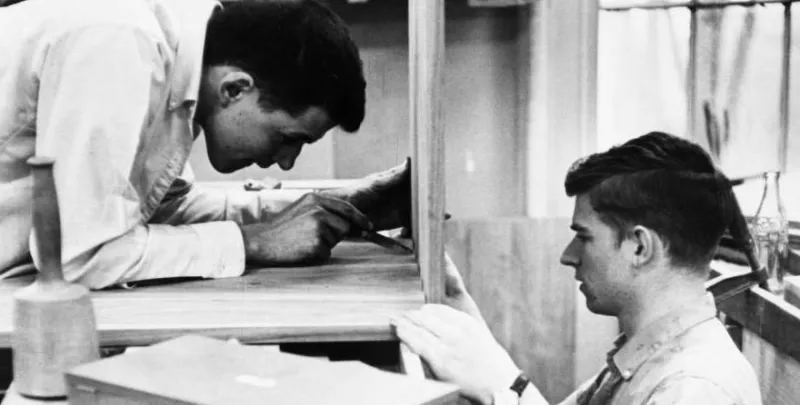
Photo: Unknown authorUnknown author, Public domain, via Wikimedia Commons
There is a particular quiet that settles over a Somerset workshop in the second week of January. The Christmas orders have gone out, the phone is slower, and the bench is swept clean with nothing urgent upon it. It is tempting to treat those weeks as dead time — to tidy the racks, sharpen everything twice and wait for the enquiries to return. The Guild would rather see them used for something that cannot be bought at a trade counter: the deliberate exchange of one skill between two workshops that would not otherwise meet.
The Case for Trading Skill Rather Than Money
Most Somerset businesses are small enough that a genuine skill gap is felt personally. A joiner in Wiveliscombe may be entirely confident in a mortise and tenon and quietly uncertain about a clean metal bracket. A fabricator near Bridgwater may be master of the weld and hesitant about a visible timber finish. Formal courses exist, but they are rarely local, rarely short and rarely cheap. What is abundant, however, is expertise sitting on benches within half an hour's drive.
The proposal is deliberately modest. Two workshops agree to pair for a single half day in January. Each teaches the other one technique — narrowly defined, demonstrable, and repeated enough times that the visitor can attempt it under supervision. No money changes hands. There is no certificate, no accreditation and no suggestion that a morning makes anyone competent. What it produces is familiarity: the visitor goes home knowing what good work looks like in a neighbouring trade, and knowing who to ring when a job sits just beyond their own competence.
That last point is the commercial heart of it. Referral trust is built on having seen someone work, not on having read their website. A joiner who has spent an afternoon in a metal shop will refer metalwork with confidence, and will be referred in turn.
Why January Suits the Exchange
The timing is not sentimental. January is when Somerset workshops have the least pressure on the diary and the most appetite for improvement before the spring bookings arrive. It is also when goodwill is easiest to offer, because nobody is turning down paid work to be there. By March, the same afternoon would cost both parties a job.
There is a practical argument too. Techniques taught in January have a season in which to be practised before they are needed in earnest. A finishing method learned in the cold weeks can be trialled on two or three small jobs before it is applied to a customer's commission in the summer.
The Shape of a Half Day
A structure that has worked well in other trades, and which the Guild recommends, runs to roughly four hours including a break.
- Arrival and briefing, thirty minutes. Both parties walk the host workshop, note the exits and the fire equipment, and confirm what will and will not be touched.
- First demonstration, one hour. The host teaches their technique with the visitor watching, then attempting, then repeating. Two attempts is the minimum; three is better.
- Break, twenty minutes. Tea, and the conversations that matter more than the timetable.
- Second demonstration, one hour. Roles reverse, either at the same bench or at the visitor's workshop on a later date.
- Close and notes, thirty minutes. Each party writes down what was learned, what tools were used and what the other party would need in order to take on a small piece of that work commercially.
The essential discipline is narrowness. "Metalwork" is not a technique. "Cutting and dressing a thread on a bench drill" is. A host who tries to teach a whole trade in an hour will teach nothing.
Agreeing the Paperwork Before the Kettle Goes On
A friendly arrangement between two sole traders is not automatically a safe one, and the Guild advises that certain matters are settled in writing beforehand — a short exchange of emails is sufficient, provided it is specific.
Insurance. Both parties should confirm with their insurers that a visitor attending for training purposes is covered, and that the host's public liability extends to a non-employee using equipment under supervision. Some policies treat this as a material change; a phone call now prevents an awkward conversation later.
Health and safety. Agree in advance which machines may be used by the visitor and which may only be observed. Confirm that personal protective equipment will be supplied by the host or brought by the visitor, and state it plainly. Identify the first-aider on site, the location of the nearest defibrillator and the procedure for an accident. Record the visitor's emergency contact.
Competence and limitation. Both parties should accept in writing that the session does not confer competence, and that the visitor will not offer the technique commercially until they are satisfied in their own judgement that they can do so safely and to standard.
Confidentiality and customers. Agree that neither party will discuss the other's clients, pricing or methods outside the session. A workshop is a private place and the exchange depends on that privacy being respected.
Tools and damage. State what happens if a tool is broken or a piece of stock is spoiled. Most such matters are settled with an offer to replace, but agreeing the principle in advance removes the sting.
What Each Side Brings Home
Beyond the technique itself, the exchange yields three things that are difficult to obtain otherwise. The first is a candid view of one's own workshop through unfamiliar eyes — visitors notice the things regular occupants have stopped seeing. The second is a named contact in an adjacent trade, with a shared afternoon behind the relationship. The third is a small, honest benchmark: what standard does this neighbouring workshop hold itself to, and how does that compare?
A Register, Not a Scheme
The Guild's role is to keep it light. We propose holding a simple register of workshops willing to host or visit in January 2027, matched by trade and by technique offered, with a short note of insurance confirmation held on file for members. The register is an introduction service, nothing more; the arrangements remain between the two businesses.
Those wishing to be listed should contact the Guild office before the middle of December, indicating the one technique they would be willing to teach and the one they would like to learn. Pairs will be introduced in the first week of the new year.
A quiet bench in January is not a wasted one. It is simply waiting for a visitor.