Their Board, Our Bench: Taking Custody of Client-Supplied Stock in a Somerset Workshop
A car pulls into the yard outside a workshop near Castle Cary. The boot opens on four boards of oak, cut some years ago from a tree on the client's family land, and the request is simple: a kitchen table, please, by spring. Nothing about the transaction is unusual in 2026. What is unusual is how rarely the workshop puts the arrangement in writing before the first cut.
Client-supplied material has become a normal feature of Somerset trade. Reclaimed slate from a demolished barn near Shepton Mallet, salvaged hinges from a Wells townhouse, a length of elm a customer bought at auction in Taunton. The commercial appeal is obvious — the client controls provenance and cost, the workshop avoids tying up capital in stock. The risk sits almost entirely at the bench.
First sight is not acceptance
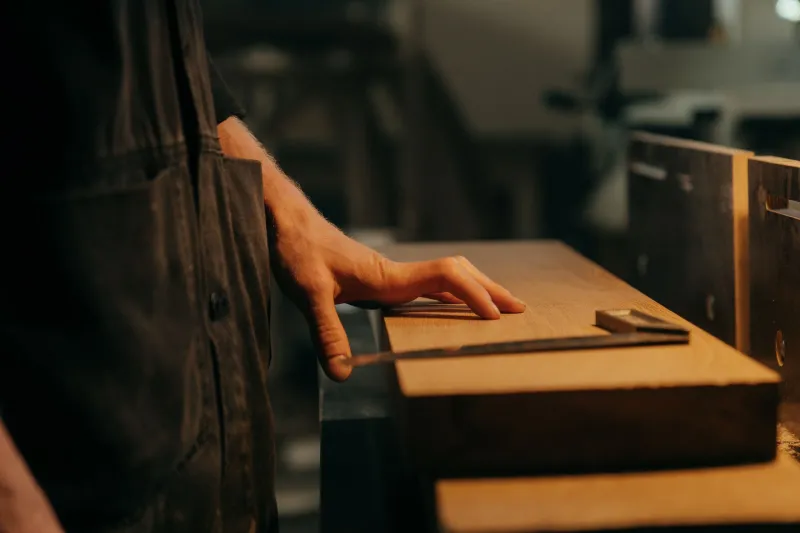
A stack of boards on a trestle is a proposition, not a commission. The first task is inspection in the client's presence, unhurried, with a note being made as you go. Look for end checking, cupping, twist, bow, and the spring that reveals itself only when a board is laid on a flat surface. Look for wane, sapwood, shake and the small dark signatures of fungal attack. Run a metal detector over anything reclaimed; a hidden cut nail will cost an hour and a saw blade, and both are yours.
Where species matters — and in joinery it usually does — confirm it rather than accept it. Elm sold as oak is a conversation nobody wants in month three. Photograph the stack as delivered, with a dated reference in the frame. That single habit resolves more disputes than any clause.
The moisture question, asked early
Moisture is the quiet argument that ends most client-material jobs badly. Take readings at three points on each board and record them. Air-dried stock kept in a Somerset outbuilding will commonly sit somewhere between fifteen and eighteen per cent; timber intended for a heated interior needs to settle closer to ten or twelve. The gap between those figures is not a technicality — it is the movement that opens a joint in February.
Say plainly what acclimatisation the workshop will provide, for how long, and where. Sticker and stack, under cover, with airflow, and a date on the calendar for re-reading. If the client's material arrives wet and the schedule does not allow a fortnight of settling, that is a decision for them to make in writing, not for you to absorb silently.
A receipt that records condition
A one-page material receipt, signed on delivery, is the most valuable document in the workshop after the insurance certificate. It needs no legal drafting. Date, description, quantity, dimensions, moisture readings, visible defects, photographs attached, and a line stating that the workshop accepts the material on the condition recorded and not otherwise. Add the client's instruction in their own words: what is to be made, and by when.
This is not defensiveness. It is the courtesy of shared understanding, and clients generally welcome it. A Somerset maker who explains why a board is being refused for a tabletop — and offers to use it for a bench instead — is demonstrating judgement, not obstructing a sale.
Where your liability ends and theirs begins
Material in your custody is material you are responsible for. The law of bailment places a duty of reasonable care on the workshop, and no disclaimer removes it entirely. What a written record does is establish the condition at the point of receipt and the standard of care that follows: dry storage, sensible handling, no unauthorised alteration.
Insurance is the part most often assumed rather than checked. Many commercial policies limit cover for customer's goods, or exclude it unless declared. Speak to your broker before the oak arrives, not after. Confirm whether the sum insured reflects the replacement value of client material on site, and note in the file what you were told. Public liability, which covers injury and damage to third parties, is not the same instrument as cover for goods in trust.
Where the material is irreplaceable — a beam from a family barn, a door from a listed property — say so and let the client decide whether to proceed. That sentence, offered early, protects the relationship better than any exclusion.
Waste, offcuts and the question of ownership
Offcuts are a genuine point of friction. A client who has paid for the tree may reasonably expect the residue back; a workshop that has quoted on the assumption of using the waste for a side project has priced accordingly. Settle it at receipt. Will offcuts be returned, retained, or disposed of at a stated charge? Are there finishes or treatments on reclaimed stock — lead paint, creosote, unknown preservatives — that make disposal a regulated matter rather than a skip?
Sawdust from treated timber should not go on the compost heap or into the wood burner without thought. A short line in the receipt covers the whole question and removes an awkward conversation later.
Storage is a cost, not a courtesy
Bench space in a Somerset workshop is not free, and a cubic metre of someone else's oak occupies it for weeks. State a storage period — thirty days beyond completion is a reasonable norm — and a weekly charge thereafter. State also what happens to uncollected material, within the bounds of reason and a solicitor's advice.
Pricing labour when the history is unknown
Fair pricing on unknown stock rests on separating the predictable from the unpredictable. Machining a known, dry, clean board is a quotable task. Flattening a twisted, grit-embedded, nail-riddled plank is not, and should be charged as a provisional sum against an hourly rate, with a stated ceiling beyond which the workshop will stop and consult.
Build in a contingency — ten to fifteen per cent is common on reclaimed and client-supplied work — and explain it. Clients accept contingency when it is described as a brake rather than a surcharge.
The form on the wall
None of this requires a legal department. It requires a single sheet, used every time, kept on file, signed by both parties. Somerset's trades have always been good at the handshake. The written record is simply the handshake given a longer memory — and it is what allows a workshop to take a client's oak, and their trust with it, without taking on a risk nobody agreed to.