Anvil, Cask and Chisel: Somerset Workshops Training the Next Generation by Hand
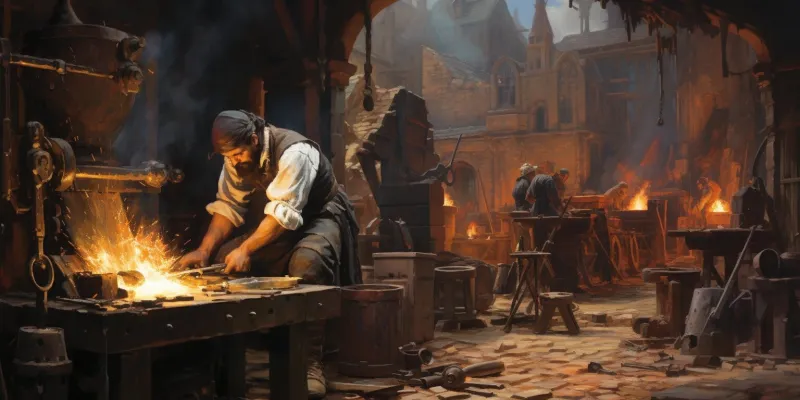
Photo: blacksmith apprentice forging metal in a Somerset workshop, via knightstemplar.co
Hand-tool trades are sometimes discussed as if they belong to a vanished Somerset. The evidence in 2026 points the other way. Across the county, workshops are teaching apprentices and short-course students to use forge, drawknife and chisel with the same care that earlier generations applied to agricultural ironwork, cider casks and church stone. Three Somerset Guild member workshops illustrate how this quiet revival works in practice, and why it matters for local procurement and heritage repair.
The forge: judgement learned at the anvil
At Rookwood Forge, a member workshop on the edge of Taunton, the first task for a new apprentice is not to make a finished piece but to understand the fire. Fire management, hammer control and the ability to read colour and scale in hot metal are taught before decorative work begins. The forge's 2026 apprenticeship follows that sequence, with bench time increasing as the trainee's judgement improves. Short courses in tool-making and forge welding run alongside the apprenticeship, giving local employers and self-employed makers a route into practical training without committing to a full programme.
The workshop's commercial work is instructive. Alongside new architectural ironwork, it repairs gates, railings, hinges and strapwork for listed buildings and older farmsteads. That repair work demands more than decorative flair. A smith must be able to match historic profiles, understand how old iron fails and decide when conservation is preferable to replacement. These are hand skills, but they are also diagnostic skills. For heritage repair, the difference between a sound repair and a damaging intervention often lies in that judgement.
For local procurement, the forge demonstrates a simple point. A Somerset building contractor repairing a Victorian school or a medieval church porch needs ironwork that fits the original and can be maintained locally. A smith working within a short drive of the site can visit, measure, advise and return if adjustment is needed. That proximity reduces transport and delay, and it keeps the repair supply chain within the county.
The cooperage: casks, cider and conservation
Coombe Cooperage, a member workshop near Bruton, works with a different set of hand tools but a similar logic. Coopers use drawknives, adzes, planes and hoop drivers to shape and secure wooden vessels. The trade is associated with Somerset cider and perry, but its skills also support breweries, food producers and historic buildings where wooden vats, tubs and fittings require repair rather than replacement.
The cooperage's 2026 training offer includes an apprenticeship and short courses for people already working in food and drink production or heritage maintenance. Apprentices begin with timber selection, grain and seasoning before moving on to jointing, shaping and hooping. The work is repetitive only in the way that all craft is repetitive: each stage builds the eye and hand until the cooper can judge fit by feel as much as by measurement.
This matters for local procurement because wooden vessels are not generic products. A cider maker needs casks that suit particular fermentation and storage practices. A historic building may need a tub or vat repaired to match existing fabric. A local cooper can discuss those requirements directly, source timber responsibly and carry out repairs that extend the life of an object rather than sending it to landfill. The carbon and cost benefits are modest individually, but they accumulate across a county with a strong food and drink sector.
The stone yard: reading stone and mortar
At Wells Stoneworks, a member stonemason's yard, training begins with the banker bench and the behaviour of lime. Apprentices learn to dress stone, cut mouldings and understand how different stones weather. They also learn why mortar choice matters. A hard cement mortar in a soft stone wall can trap moisture and accelerate decay, so the mason's hand skills are inseparable from material knowledge.
The yard's 2026 programme combines apprenticeship training with short courses in lime pointing and stone carving. The short courses are particularly useful for property owners, maintenance staff and contractors who need to understand repair principles even if they do not intend to become full-time masons. The apprenticeship, by contrast, is for those preparing to work on churches, boundary walls, farm buildings and listed houses across Somerset.
Heritage repair depends on this kind of training. Local stone, compatible mortar and appropriate tooling are not optional refinements; they are the basis of durable work. A stonemason working within 30 miles of a site can assess the existing fabric, identify stone types and return for later inspection. That is local procurement in its most practical form: not a slogan, but a chain of knowledge, material and labour that stays close to the building it serves.
What prospective trainees should look for
A workshop-based course is only as good as the work it produces. Prospective trainees should ask to see examples of the workshop's own commercial output, not just demonstration pieces made for teaching. They should also ask how much time is spent at the bench compared with watching, and whether tools and materials are provided or must be bought.
Other questions are equally practical. Does the course cover repair as well as new work? Is health and safety training included? What progression exists from a short course into an apprenticeship or paid employment? Does the workshop work on local heritage projects that would give a trainee relevant experience? And is the workshop a Somerset Guild member, with the peer network and local supply contacts that membership implies?
Cost and flexibility matter, particularly for career changers and small employers. A short course can be a sensible first step before a longer commitment. An apprenticeship requires a greater investment of time, but it offers sustained practice under supervision. The right choice depends on the trainee's existing skills, available time and intended route into work.
Why hand tools still matter
Hand-tool trades are not a nostalgic add-on to Somerset's economy. They provide repairability, material sensitivity and diagnostic skill that cannot be replaced by standardised products alone. They also support local procurement by keeping specialist knowledge, timber, stone and ironwork within reach of the sites and businesses that need them.
The revival is quiet because it happens at the bench, one apprentice and one repair at a time. But it is real. In 2026, Somerset workshops are training people to use hand tools not as museum exhibits but as working equipment for a county that still needs things made, maintained and repaired well.